
How Long to Rest Between Sets: Science Guide
Short answer
Rest 2 to 3 minutes between heavy compound sets (squats, bench press, deadlifts, rows) and 1 to 2 minutes between single-joint isolation sets. For maximal strength lifts above 85% 1RM, rest 3 to 5 minutes. Longer rests preserve reps and volume better than 60-second rests (Schoenfeld 2016), with hypertrophy gains largely leveling off past about 2 minutes (Singer 2024).
How long should you rest by goal and exercise type?
Match your rest period to how much systemic fatigue the movement creates and how heavy the load is relative to your maximum. Multi-joint free-weight lifts tax your breathing, grip, stabilizers, and central nervous system far more than single-joint machine or dumbbell isolations.
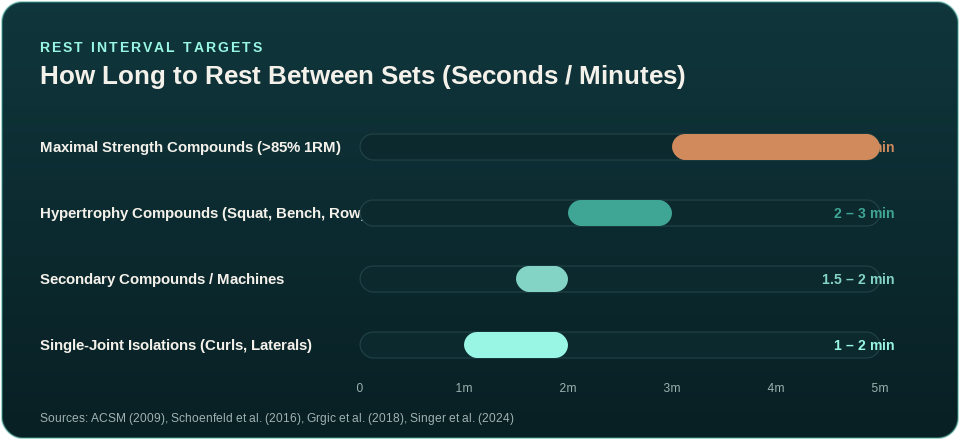
Use this lookup table on the gym floor:
| Exercise Category | Hypertrophy (6–15 reps) | Maximal Strength (1–5 reps) | Example Lifts |
|---|---|---|---|
| Heavy multi-joint compounds | 2 – 3 min | 3 – 5 min | Barbell Squat, Barbell Bench Press, Barbell Deadlift |
| Secondary compounds & machines | 1.5 – 2 min | 2 – 3 min | Leg press, lat pulldown, incline dumbbell press |
| Single-joint isolations | 1 – 2 min | 1.5 – 2 min | Side Lateral Raise, Dumbbell Bicep Curl, leg curl |
This aligns directly with the ACSM (2009) position stand (2 to 3 minutes minimum for core multi-joint exercises and 1 to 2 minutes for assistance lifts) while updating older bodybuilding advice that pushed 60-second rests for everything.
What does the research actually say about 1-minute vs. 3-minute rests?
Older gym lore claimed 45 to 60 seconds of rest built more muscle because short rests produced a bigger temporary spike in post-workout hormones and a stronger pump. Controlled training studies have since shown that mechanical tension and total high-quality volume matter far more than acute hormone fluctuations.
Three landmark papers tell the full story:
- Schoenfeld et al. (2016): Resistance-trained men performed the same full-body routine for 8 weeks using either 1-minute or 3-minute rest intervals. The 3-minute group gained significantly more 1RM strength in both the back squat and bench press, and achieved greater muscle thickness increases in the quadriceps and triceps—largely because longer rests let them maintain heavier loads and more total volume across sets.
- Grgic et al. (2018): A systematic review of 23 studies on muscular strength concluded that trained lifters get larger strength gains from rest intervals longer than 2 minutes on multi-joint lifts, while novices can still make strong early gains with shorter 1-to-2-minute rests because absolute loads are lower.
- Singer et al. (2024): A Bayesian meta-analysis pooling hypertrophy studies found a small muscle-growth advantage for resting longer than 60 seconds compared to 60 seconds or less, with diminishing returns beyond roughly 90 to 120 seconds on many lifts.
The practical takeaway is clear: avoid cutting compound rests down to 60 seconds, aim for 2 to 3 minutes on big compounds (up to 3–5 minutes when lifting above 85% of your 1RM), and use 1 to 2 minutes on smaller isolation lifts where systemic fatigue is low.
How much volume do short rest periods cost you?
Seeing the arithmetic makes the difference obvious. Imagine a lifter whose 1RM on the barbell bench press is 225 lb (102 kg), working at 175 lb (80 kg) for 4 sets targeting 8 to 10 reps (about 78% 1RM—you can find your own percentages on our 1RM calculator).
| Set | 60-Second Rest (Rushed) | 150-Second (2.5-Min) Rest |
|---|---|---|
| Set 1 | 175 lb × 9 reps = 1,575 lb (720 kg) | 175 lb × 9 reps = 1,575 lb (720 kg) |
| Set 2 | 175 lb × 7 reps = 1,225 lb (560 kg) | 175 lb × 9 reps = 1,575 lb (720 kg) |
| Set 3 | 175 lb × 6 reps = 1,050 lb (480 kg) | 175 lb × 8 reps = 1,400 lb (640 kg) |
| Set 4 | 175 lb × 5 reps = 875 lb (400 kg) | 175 lb × 8 reps = 1,400 lb (640 kg) |
| Total | 27 reps · 4,725 lb (2,160 kg) | 34 reps · 5,950 lb (2,720 kg) |
Resting 2.5 minutes instead of 1 minute added 7 hard working reps (+26% more volume load) at the exact same weight without adding a single extra set. Across an 8-week block of progressive overload, those extra reps per session add up to faster progression and cleaner technique on Sets 3 and 4.
How can you save time in the gym without cutting recovery?
Longer rests do not have to turn a 45-minute workout into a 90-minute marathon. Many coaches use antagonist supersets—pairing two exercises that train opposing muscles—to keep local muscle rest at 2 to 3 minutes while cutting total gym time nearly in half.
Here is how the clock works when pairing Dumbbell Bicep Curls with Rope Triceps Pushdowns (or Seated Cable Rows with Incline Dumbbell Presses):
- 0:00 – 0:40: Perform Set 1 of Bicep Curls (40 seconds).
- 0:40 – 1:25: Rest 45 seconds (catch your breath).
- 1:25 – 2:05: Perform Set 1 of Triceps Pushdowns (40 seconds).
- 2:05 – 2:50: Rest 45 seconds.
- 2:50: Start Set 2 of Bicep Curls.
Look at the math: your biceps rested 2 minutes and 10 seconds (0:40 to 2:50), and your triceps will also rest 2 minutes and 10 seconds—yet you only waited 45 seconds between exercises. Reserve supersets for upper-body push/pull pairs or arm isolations; keep heavy barbell squats and barbell deadlifts as straight sets so systemic breathing fatigue does not compromise bracing.
Why does an automatic rest timer change your results?
Without a timer, two quiet habits creep into almost every workout: either you rush Set 2 after 45 seconds because you feel impatient, or you open your phone between sets and accidentally turn a 2-minute rest into 6 minutes of scrolling. Consistent rest intervals turn your workout log into an apples-to-apples comparison from week to week—if you hit 175 lb × 9, 9, 8 on 2.5-minute rests this week and 9, 9, 9 on 2.5-minute rests next week, you know your strength truly improved.
In Setload on iPhone, checking off a set starts the exercise’s rest timer automatically on your Lock Screen and Dynamic Island with +30s and Skip controls, matching the exact rest times programmed into free plans like Full Body 3×.
What are the most common rest-period mistakes?
- Chasing a burn instead of performance on compounds. A burning chest from 45-second bench rests feels intense, yet cuts your working reps by 20–30% on later sets. Judge rest quality by whether your reps hold steady across sets.
- Using the same timer for every exercise. Deadlifts at 85% 1RM need 3 minutes or more; lateral raises need 60 to 90 seconds. Set different rest defaults for heavy compounds versus isolations.
- Resting so long you cool down. Beyond 5 to 6 minutes on normal hypertrophy sets, arousal drops and workouts drag unnecessarily without meaningful extra rep recovery.
- Ignoring dizziness or joint discomfort. If your heart rate has not settled after a heavy squat set, take an extra 30 to 60 seconds rather than rushing under the bar. If something hurts, stop and ask a qualified professional.
Questions people ask
Is 3 minutes rest between sets too long for muscle growth?
No. Schoenfeld et al. (2016) showed that 3-minute rests produced greater muscle thickness gains in the quads and triceps than 1-minute rests in trained men. For heavy compound lifts like squats, bench press, and rows, 2 to 3 minutes is ideal for hypertrophy.
Can I rest only 60 seconds if I am short on time?
You can use 60-to-90-second rests on single-joint isolation exercises (curls, pushdowns, calf raises, lateral raises) with little downside (Singer 2024). On heavy compounds, antagonist supersets are a much better time-saver than cutting straight-set rest down to 60 seconds.
How do I know if I rested long enough before the next set?
Use a simple two-part check: your breathing has returned close to normal, and your target muscle feels ready to match (or come within 1 rep of) the previous set’s performance. If your reps drop by 3 or more from Set 1 to Set 2 at the same weight, add 30 to 60 seconds of rest.
Do warm-up sets need the same 2–3 minute rest?
No. Early warm-up sets (empty bar and 40–60% working weight—easily planned with our barbell plate calculator) only need the time it takes to load the next plates. Take 90 to 120 seconds after your final heavy warm-up set (around 80%) so you enter Set 1 fresh.
Sources
- Progression Models in Resistance Training for Healthy Adults. Medicine & Science in Sports & Exercise, 41(3):687-708. https://doi.org/10.1249/MSS.0b013e3181915670
- Longer Interset Rest Periods Enhance Muscle Strength and Hypertrophy in Resistance-Trained Men. Journal of Strength and Conditioning Research, 30(7):1805-1812. https://doi.org/10.1519/JSC.0000000000001272
- Effects of Rest Interval Duration in Resistance Training on Measures of Muscular Strength: A Systematic Review. Sports Medicine, 48(1):137-151. https://doi.org/10.1007/s40279-017-0788-x
- Give it a rest: a systematic review with Bayesian meta-analysis on the effect of inter-set rest interval duration on muscle hypertrophy. Frontiers in Sports and Active Living, 6:1429789. https://doi.org/10.3389/fspor.2024.1429789