
Push Pull Legs Split: 3-Day & 6-Day Templates
Short answer
The Push Pull Legs (PPL) split groups exercises by movement pattern: Push trains chest, shoulders, and triceps; Pull trains back, rear delts, and biceps; Legs trains quads, hamstrings, glutes, and calves. Run a 3-day rotating schedule if you are newer or busy, or a 6-day A/B schedule to hit every muscle twice weekly for 12 to 16 direct sets.
How does the Push Pull Legs split work?
Push Pull Legs divides every exercise in your routine into three non-overlapping movement patterns so the muscles that assist each other work on the same day and recover together afterward. That eliminates the overlap problem common in body-part splits, where training shoulders the day after chest leaves your front delts and triceps fatigued.
Each session focuses on one clear group of muscles:
- Push day: Chest, front and side delts, and triceps. Primary movements include horizontal presses like the barbell bench press and vertical presses like the barbell shoulder press.
- Pull day: Lats, upper back, traps, rear delts, and biceps. Primary movements include rows such as the bent-over barbell row, pull-ups, and lat pulldowns.
- Legs day: Quads, hamstrings, glutes, calves, and abs. Primary movements include squat patterns such as the barbell squat and hip hinges such as the Romanian deadlift.
Because pushing muscles rest during Pull and Legs days, you get 72 hours of recovery before training the same muscle group again—even when you lift six days per week.
Should you run a 3-day rotating or 6-day PPL schedule?
Choose your PPL frequency based on how many days you can consistently make it to the gym and how many weekly sets you need to grow. A meta-analysis by Schoenfeld et al. (2016) found that training a muscle group twice per week produced better hypertrophy than once per week when comparing typical programs, while a follow-up analysis (Schoenfeld 2019) showed that when total weekly sets are matched, frequency itself plays a much smaller independent role.
In practical terms, frequency is a tool for distributing weekly volume cleanly. Doing 14 hard sets of chest in a single Monday session degrades set quality by set 10; splitting those 14 sets into two 7-set Push days keeps bar speed, weight, and form high. Weekly volume itself shows a graded dose-response relationship with muscle growth, with 10 or more weekly sets per muscle outperforming fewer than 5 sets (Schoenfeld 2017).
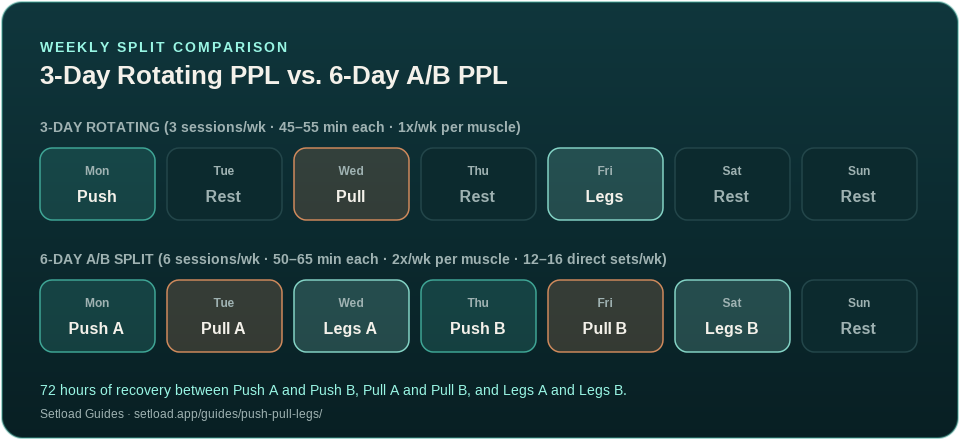
Use the table below to compare the exact weekly set volume delivered by a 3-day rotating PPL versus a 6-day A/B PPL.
| Feature or Muscle Group | 3-Day Rotating PPL | 6-Day A/B PPL |
|---|---|---|
| Sessions per week | 3 days (Mon / Wed / Fri) | 6 days (Mon–Sat, Sun rest) |
| Frequency per muscle | 1× per week (or 1.5× if rotating 4–5 days) | 2× per week (72 hr between repeats) |
| Typical session length | 45–55 minutes | 50–65 minutes |
| Direct chest sets / week | 4 sets (+ 3 incline if added) | 10–13 sets |
| Direct back (lats + upper) sets / week | 7 sets | 14–16 sets |
| Direct quad sets / week | 7 sets | 13 sets |
| Direct hamstring sets / week | 3 sets | 6–9 sets |
| Direct biceps / triceps sets / week | 3 direct (+ compound indirect) | 6 direct (+ compound indirect) |
| Best fit | Busy lifters, early intermediates, tight recovery | Intermediates with 6 days/wk and solid sleep |
Notice the main drawback of a strict 3-day PPL: each muscle gets 3 to 7 direct sets once per week. Many coaches solve this either by running PPL on a 4-day or 5-day rolling rotation (Push, Pull, Legs, Rest, repeat) or by choosing a 3-day full-body routine when limited to three fixed days per week. See our guide on how many sets per week to build muscle for full set budgets.
What is a complete 6-day Push Pull Legs workout template?
A 6-day PPL works best with an A/B rotation rather than repeating identical workouts twice a week. Push A leads with bench press and Push B leads with overhead press; Legs A leads with squats and Legs B leads with deadlifts. Rest 2.5 minutes (150 seconds) on heavy compounds and 90 seconds on isolations (ACSM 2009; see how long to rest between sets).
Rotation A (Days 1–3)
| Day | Exercise | Sets × Reps | Rest | Progression |
|---|---|---|---|---|
| Push A | Barbell Bench Press | 4 × 6–10 | 2.5 min | Double progression |
| Push A | Seated Dumbbell Press | 3 × 8–12 | 2.5 min | Double progression |
| Push A | Incline Dumbbell Press | 3 × 10–15 | 90 sec | Double progression |
| Push A | Side Lateral Raise | 3 × 12–20 | 90 sec | Double progression |
| Push A | Rope Triceps Pushdown | 3 × 10–15 | 90 sec | Double progression |
| Pull A | Bent-Over Barbell Row | 4 × 6–10 | 2.5 min | Double progression |
| Pull A | Wide-Grip Lat Pulldown | 3 × 8–12 | 2.5 min | Double progression |
| Pull A | Seated Cable Row | 3 × 10–15 | 90 sec | Double progression |
| Pull A | Face Pull | 3 × 12–20 | 90 sec | Double progression |
| Pull A | Dumbbell Bicep Curl | 3 × 10–15 | 90 sec | Double progression |
| Legs A | Barbell Squat | 4 × 5–8 | 2.5 min | Double progression |
| Legs A | Romanian Deadlift | 3 × 8–12 | 2.5 min | Double progression |
| Legs A | Leg Press | 3 × 10–15 | 2.5 min | Double progression |
| Legs A | Lying Leg Curl | 3 × 10–15 | 90 sec | Double progression |
| Legs A | Standing Calf Raise | 4 × 10–15 | 90 sec | Double progression |
Rotation B (Days 4–6)
| Day | Exercise | Sets × Reps | Rest | Progression |
|---|---|---|---|---|
| Push B | Barbell Shoulder Press | 4 × 6–10 | 2.5 min | Double progression |
| Push B | Dumbbell Bench Press | 3 × 8–12 | 2.5 min | Double progression |
| Push B | Dumbbell Flyes | 3 × 12–15 | 90 sec | Double progression |
| Push B | Side Lateral Raise | 3 × 12–20 | 90 sec | Double progression |
| Push B | Triceps Dips | 3 × 6–12 | 90 sec | Double progression |
| Pull B | Pull-Ups | 4 × 5–10 | 2.5 min | Double progression |
| Pull B | Barbell Shrug | 3 × 10–15 | 90 sec | Double progression |
| Pull B | Seated Cable Row | 3 × 10–15 | 90 sec | Double progression |
| Pull B | Cable Rear Delt Fly | 3 × 12–20 | 90 sec | Double progression |
| Pull B | Hammer Curl | 3 × 10–15 | 90 sec | Double progression |
| Legs B | Barbell Deadlift | 3 × 3–6 | 2.5 min | Double progression |
| Legs B | Front Barbell Squat | 3 × 8–12 | 2.5 min | Double progression |
| Legs B | Barbell Hip Thrust | 3 × 8–12 | 2.5 min | Double progression |
| Legs B | Leg Extension | 3 × 12–20 | 90 sec | Double progression |
| Legs B | Hanging Leg Raise | 3 × 8–15 | 90 sec | Double progression |
Day 7 is full rest. If your lower back feels worn down placing Pull A (barbell rows) right before Legs A (squats and RDLs), swap the order to Pull, Push, Legs so Push day separates your heavy back work from your heavy leg work.
What is a complete 3-day rotating PPL workout template?
A 3-day rotating PPL trims each workout to four focused exercises (14–15 working sets per session) so you finish in under 50 minutes without rushing rest periods. You can run it Monday/Wednesday/Friday, or roll it continuously whenever you have time to train (for example, 4 days one week, 3 days the next) without breaking the sequence.
| Day | Exercise | Sets × Reps | Rest |
|---|---|---|---|
| Push | Barbell Bench Press | 4 × 6–10 | 2.5 min |
| Push | Seated Dumbbell Press | 3 × 8–12 | 2.5 min |
| Push | Side Lateral Raise | 3 × 12–20 | 90 sec |
| Push | Rope Triceps Pushdown | 3 × 10–15 | 90 sec |
| Pull | Bent-Over Barbell Row | 4 × 6–10 | 2.5 min |
| Pull | Wide-Grip Lat Pulldown | 3 × 8–12 | 2.5 min |
| Pull | Face Pull | 3 × 12–20 | 90 sec |
| Pull | Dumbbell Bicep Curl | 3 × 10–15 | 90 sec |
| Legs | Barbell Squat | 4 × 5–8 | 2.5 min |
| Legs | Romanian Deadlift | 3 × 8–12 | 2.5 min |
| Legs | Leg Extension | 3 × 12–20 | 90 sec |
| Legs | Standing Calf Raise | 4 × 10–15 | 90 sec |
Both templates above are built directly into Setload with automatic double-progression targets—see the full day-by-day tables on our Push / Pull / Legs 6× and Push / Pull / Legs (rotating) program pages (both are included in Setload Pro).
How do you progress weight and reps on PPL each week?
Most lifters stall on PPL because they either chase weight jumps before owning the reps or repeat the same comfortable weight for months. The cleanest engine for PPL is double progression, which aligns with ACSM (2009) progression principles of increasing resistance by 2 to 10% once you consistently exceed your target rep count.
Here is how double progression works across 4 weeks on Push A: Barbell Bench Press (4 sets × 6–10 reps) starting at 155 lb (70 kg) on a 45 lb (20 kg) bar:
| Week | Working Load | Reps Logged (4 Sets) | Total Volume | Next Session Decision |
|---|---|---|---|---|
| Week 1 | 155 lb (70 kg) | 9, 8, 8, 7 (32 reps) | 4,960 lb (2,240 kg) | Hold 155 lb; push for more reps |
| Week 2 | 155 lb (70 kg) | 10, 9, 9, 8 (36 reps) | 5,580 lb (2,520 kg) | Hold 155 lb; close to top of range |
| Week 3 | 155 lb (70 kg) | 10, 10, 10, 10 (40 reps) | 6,200 lb (2,800 kg) | All 4 sets hit 10 → add 5 lb (2.5 kg) |
| Week 4 | 160 lb (72.5 kg) | 8, 8, 7, 7 (30 reps) | 4,800 lb (2,175 kg) | Hold 160 lb; climb back toward 4 × 10 |
Notice the arithmetic: moving from 155 lb to 160 lb is a 3.2% load jump (from 70 kg to 72.5 kg is a 3.6% jump)—right inside the ACSM (2009) 2–10% window. Adding 5 lb requires just one 2.5 lb plate per side (or one 1.25 kg plate per side on metric bars). You can check exact plate loading and warm-up sets with our barbell plate calculator or track estimated maxes with the 1RM calculator. For a deeper breakdown of when to add weight versus reps, read our progressive overload guide.
What are the most common Push Pull Legs mistakes?
- Running 6 days on a 4-day recovery budget. When sleep drops under 7 hours or your week gets busy, forcing six sessions builds fatigue faster than muscle. Drop to a 4-to-5-day rolling rotation instead.
- Putting deadlifts on Pull day right before Legs day. Heavy deadlifts fatigue your lower back and hamstrings before squats. Place deadlifts on Legs B or insert a rest day between Pull and Legs.
- Grinding every set to failure. Leave 1 to 2 clean reps in reserve on compound lifts and save near-failure sets for the final set of safe isolations.
- Skipping warm-up sets. Take 3 to 4 progressive warm-up sets (empty bar, 40%, 60%, 80%) before Set 1. If something hurts, stop and ask a qualified professional.
Questions people ask
Is Push Pull Legs good for beginners?
A 3-day rotating PPL can work for beginners who already know basic barbell and dumbbell form, though most complete beginners progress faster on a 3-day full-body routine because each movement pattern is practiced three times per week instead of once. Once you have 3 to 6 months of consistent lifting behind you, PPL becomes much easier to recover from and scale.
Can you run Push Pull Legs 4 or 5 days a week?
Yes. Instead of locking Push to Monday, simply rotate through Push, Pull, Legs on whichever 4 or 5 days you train that week (for example: Week 1 = Push, Pull, Legs, Push; Week 2 = Pull, Legs, Push, Pull). That keeps every muscle hitting roughly 1.3 to 1.7 times per week without burning out on a strict 6-day calendar.
Should Pull come before Push, or Push before Pull?
Either order works. Many lifters prefer Pull, Push, Legs, Rest because putting Push between Pull and Legs gives the lower back 48 hours between heavy rows and heavy squats or deadlifts. Pick whichever sequence keeps your main compound lifts feeling freshest.
Where do abs fit in a Push Pull Legs split?
Abs fit cleanly at the end of Legs day (such as 3 sets of hanging leg raises on Legs B, as shown in the 6-day template above) because your grip and upper body are already fresh on Legs day and ab fatigue will not interfere with heavy squats or deadlifts once they are placed last.
Sources
- Progression Models in Resistance Training for Healthy Adults. Medicine & Science in Sports & Exercise, 41(3):687-708. https://doi.org/10.1249/MSS.0b013e3181915670
- Effects of Resistance Training Frequency on Measures of Muscle Hypertrophy: A Systematic Review and Meta-Analysis. Sports Medicine, 46(11):1689-1697. https://doi.org/10.1007/s40279-016-0543-8
- Dose-response relationship between weekly resistance training volume and increases in muscle mass: A systematic review and meta-analysis. Journal of Sports Sciences, 35(11):1073-1082. https://doi.org/10.1080/02640414.2016.1210197
- How many times per week should a muscle be trained to maximize muscle hypertrophy? A systematic review and meta-analysis of studies examining the effects of resistance training frequency. Journal of Sports Sciences, 37(11):1286-1295. https://doi.org/10.1080/02640414.2018.1555906