
How to Increase Your Bench Press: 12-Week Plan
Short answer
To increase your bench press, bench twice per week with one heavy strength day (3 to 5 reps at 77.5 to 87.5% 1RM) and one volume day (6 to 8 reps at 70 to 77.5% 1RM), rest 2.5 to 3 minutes between sets (Schoenfeld 2016), and pair weak-point accessories. Heavy loads drive maximal strength gains (Schoenfeld 2017) while weekly volume builds pressing muscle.
Why does your bench press stall—and what actually moves it?
Most lifters stall on the barbell bench press for three predictable reasons: they bench only once per week, they test maxes or grind to failure every session instead of building quality volume, or they rest 60 to 90 seconds between sets.
Peer-reviewed evidence points directly to what moves a stalled bench:
- Load specificity: Higher loads (above 60% 1RM, especially 80–90% 1RM) produce significantly larger 1RM strength increases than lighter sets (Schoenfeld 2017; ACSM 2009).
- Adequate rest: Schoenfeld et al. (2016) found that resting 3 minutes between sets produced significantly greater bench press 1RM gains than 1-minute rests in trained men.
- Frequency and volume: Benching twice per week (72 hours apart, such as Monday and Thursday) lets you accumulate 8 to 12 high-quality barbell sets per week without trashing your shoulders in a single marathon Monday chest session.
What does a 12-week bench press program look like?
This 12-week block uses two structured bench days per week: Day 1 (Heavy Strength) builds neural force at 77.5–87.5% of your training 1RM, while Day 2 (Volume & Technique) builds pressing muscle at 70–77.5% with controlled 1-second chest pauses. Weeks 4 and 8 pull volume and intensity back to dissipate fatigue before the next jump.
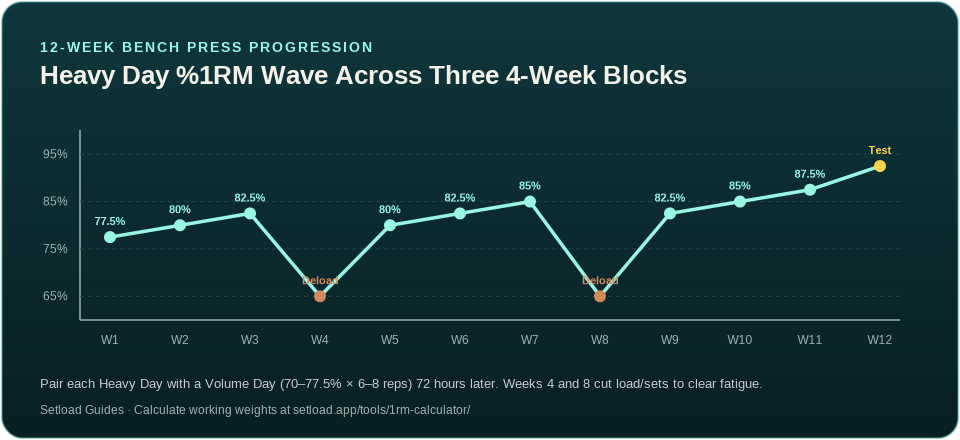
| Week | Block | Day 1: Heavy Bench | Day 2: Volume Bench (1-sec pause) | Rest |
|---|---|---|---|---|
| Week 1 | Block 1 | 4 × 5 @ 77.5% | 4 × 8 @ 70% | 3 min / 2.5 min |
| Week 2 | Block 1 | 4 × 5 @ 80% | 4 × 8 @ 72.5% | 3 min / 2.5 min |
| Week 3 | Block 1 | 4 × 4 @ 82.5% | 4 × 7 @ 75% | 3 min / 2.5 min |
| Week 4 | Deload | 3 × 5 @ 65% | 3 × 6 @ 60% | 2 min |
| Week 5 | Block 2 | 4 × 4 @ 80% | 4 × 7 @ 72.5% | 3 min / 2.5 min |
| Week 6 | Block 2 | 4 × 4 @ 82.5% | 4 × 7 @ 75% | 3 min / 2.5 min |
| Week 7 | Block 2 | 4 × 3 @ 85% | 4 × 6 @ 77.5% | 3 min / 2.5 min |
| Week 8 | Deload | 3 × 4 @ 65% | 3 × 5 @ 60% | 2 min |
| Week 9 | Block 3 | 4 × 3 @ 82.5% | 4 × 6 @ 75% | 3 min / 2.5 min |
| Week 10 | Block 3 | 4 × 3 @ 85% | 4 × 5 @ 77.5% | 3 min / 2.5 min |
| Week 11 | Block 3 | 3 × 2 @ 87.5% | 3 × 5 @ 72.5% | 3–4 min / 2.5 min |
| Week 12 | Peak / Test | Work up to 1RM or 3RM @ RPE 9.5 | Light 3 × 5 @ 60% | 4 min |
Start from a conservative true or estimated 1RM (never an old max from two years ago). Plug a recent clean 3-to-8-rep set into our 1RM calculator (using the Epley formula, Epley 1985) so Week 1 feels smooth around RPE 7.5–8 (see our RPE and RIR guide).
How do the weights and barbell plates work in practice?
Here is the exact working-weight and per-side plate math for an intermediate lifter starting with a 200 lb (90 kg) 1RM on a standard 45 lb (20 kg) Olympic bar (rounded to loadable 5 lb / 2.5 kg gym increments):
| Milestone Week | Target %1RM | Working Load (lb) | Plates Per Side (45 lb Bar) | Metric Equivalent (90 kg 1RM, 20 kg Bar) |
|---|---|---|---|---|
| Week 1 Heavy (4 × 5) | 77.5% | 155 lb | 45 + 10 | 70 kg (20 + 5 per side) |
| Week 3 Heavy (4 × 4) | 82.5% | 165 lb | 45 + 10 + 5 | 75 kg (20 + 5 + 2.5 per side) |
| Week 4 Deload (3 × 5) | 65% | 130 lb | 35 + 5 + 2.5 | 57.5 kg (15 + 2.5 + 1.25 per side) |
| Week 7 Heavy (4 × 3) | 85% | 170 lb | 45 + 10 + 5 + 2.5 | 77.5 kg (20 + 5 + 2.5 + 1.25 per side) |
| Week 11 Heavy (3 × 2) | 87.5% | 175 lb | 45 + 10 + 10 | 80 kg (20 + 10 per side) |
| Week 12 Retest Goal | 102.5–105% | 205–210 lb | 45 + 35 (205 lb) | 92.5–95 kg (20 + 15 + 1.25–2.5 per side) |
Notice how cleanly the 2.5 lb (1.25 kg) plates bridge Weeks 3, 7, and 11. Trying to jump by 10 lb (5 kg) plates on bench press skips right over optimal loading steps. Check your exact warm-up sets and per-side plates before walking up to the bench with our barbell plate calculator—and if you want a full-body strength split that builds bench alongside squat and deadlift, see Setload’s Squat, Bench, Deadlift 3× program (included in Setload Pro) or the free Beginner 5×5 plan.
Which accessories fix your specific bench sticking point?
Add two targeted accessory lifts (3 sets × 8–12 reps each) after your main barbell bench work based on where heavy reps actually slow down or stall:
| Where the Bar Stalls | Likely Bottleneck | Best Accessory Pairings |
|---|---|---|
| Right off the chest | Starting strength, pecs, paused tension | Paused bench press (already on Day 2) + Incline Dumbbell Press |
| Mid-range (3–5 in above chest) | Pec-to-tricep transition, anterior delts | Incline Dumbbell Press + Dips (Triceps Version) |
| Top third / lockout | Triceps strength and elbow extension | Close-Grip Barbell Bench Press + Dips (Triceps Version) |
| Bar drifts or shoulders lose tightness | Upper-back shelf & lat stability | Bent-Over Barbell Row + face pulls / rear delt work |
Balance every horizontal press set with at least an equal number of horizontal pulling sets (rows) each week. A strong upper back creates a rigid base on the bench and keeps your shoulders aligned under heavy loads.
Which technique cues protect your shoulders and add stability?
Five concrete setup habits add immediate stability without complicated powerlifting gear:
- Five points of contact: Keep your head, upper back, glutes, and both feet planted solidly. Driving your feet gently back toward your hips keeps your torso tight without lifting your glutes off the pad.
- Pack your shoulder blades: Pull your shoulder blades slightly back and down into the bench before unracking, creating a natural, comfortable upper-back arch.
- Forearms stacked at the bottom: Pick a grip width where your forearms stay roughly vertical when the bar touches your lower chest (around sternum level).
- Slight elbow tuck (roughly 45–60 degrees): Avoid flaring your elbows out to 90 degrees in line with your shoulders; a moderate tuck keeps the bar path smooth and comfortable.
- Use safeties or a spotter on heavy weeks: Set rack safety pins just below chest-arch height whenever you bench alone. If something hurts—especially sharp anterior shoulder pain—stop and ask a qualified professional.
What are the most common bench press mistakes?
- Testing a 1RM every Monday. Maxing out weekly creates high fatigue and low productive training volume. Save retesting for Week 12 or track progress safely via estimated 1RM from 3-to-5-rep sets.
- Bouncing the bar off the sternum. Momentum steals strength right at the hardest part of the lift—off the chest. Day 2’s 1-second pause breaks that habit in two weeks.
- Rushing rest intervals. Dropping from 3 minutes to 60 seconds cuts later-set reps sharply and slows bench 1RM progression (Schoenfeld 2016; see how long to rest between sets).
- Neglecting upper-back rowing. Pressing three times as much as you row leaves your bench setup unstable when weights cross 80% 1RM.
Questions people ask
How much can I increase my bench press in 12 weeks?
Novices running linear progression can often add 20 to 40 lb (10 to 20 kg) in 12 weeks. Intermediates who already bench near bodyweight typically see a realistic 5 to 15 lb (2.5 to 7.5 kg) true 1RM gain over a clean 12-week wave.
Is benching twice a week better than once a week?
For most lifters past the novice stage, yes. Benching twice weekly splits 8 to 10 high-quality sets across two fresh sessions, lets you pair heavy low-rep work with paused volume work, and doubles your weekly technique practice.
What if I fail a rep during Week 6 or Week 10?
Do not push on to a heavier weight the next week. Drop the load 5% on remaining sets that day, check your sleep and rest intervals, and repeat that week’s target load the following session before moving forward (see our progressive overload guide).
Should I pause every bench press rep or touch-and-go?
Keep Day 1 as controlled touch-and-go (light touch on the chest, zero bounce) to build confidence with heavier loads, and use a clear 1-second pause on Day 2 to build power out of the bottom position.
Sources
- Strength and Hypertrophy Adaptations Between Low- vs. High-Load Resistance Training: A Systematic Review and Meta-analysis. Journal of Strength and Conditioning Research, 31(12):3508-3523. https://doi.org/10.1519/JSC.0000000000002200
- Progression Models in Resistance Training for Healthy Adults. Medicine & Science in Sports & Exercise, 41(3):687-708. https://doi.org/10.1249/MSS.0b013e3181915670
- Longer Interset Rest Periods Enhance Muscle Strength and Hypertrophy in Resistance-Trained Men. Journal of Strength and Conditioning Research, 30(7):1805-1812. https://doi.org/10.1519/JSC.0000000000001272
- Poundage Chart. Boyd Epley Workout, Lincoln, NE (chart).